Reviewing Single, Taken, Hungry for Embroidery
As a designer who has spent countless hours digitizing and stitching out thousands of designs, I approach every new file with a mix of curiosity and skepticism. We all know that what looks crisp on a screen does not always translate well to fabric. When I first encountered Single, Taken, Hungry, my immediate reaction was one of amusement followed by practical assessment. This design falls under the category of Freebies and Graphics, which often raises questions about quality and usability. However, after reviewing the assets and considering its application in real-world projects, I found it to be a versatile asset for specific niches.
First Impressions and Visual Personality
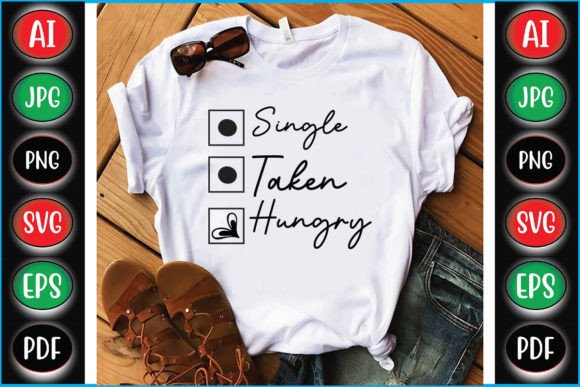
The phrase "Single, Taken, Hungry" carries a playful, relatable mood that resonates with modern humor. It is not just a statement; it is a conversation starter. Visually, the layout appears balanced, likely relying on bold typography to ensure readability from a distance. For an embroidery project, clarity is king. If the letters are too thin or the spacing too tight, the thread will merge, creating a muddy mess rather than a witty slogan.
What stands out here is the potential for personality. This is not a formal monogram or a delicate floral motif. It is bold, casual, and slightly irreverent. This visual personality makes it ideal for casual wear and lifestyle items. The design does not try to be overly intricate, which is a blessing for machine embroidery. Complex gradients and tiny details often fail in stitching, but a strong typographic design like this tends to hold up well, provided the digitization respects the limitations of the needle and thread.
Real-World Application: The Custom Tote Bag Scenario
To truly evaluate Single, Taken, Hungry, I imagined a specific client request. A local boutique owner wanted to create a line of canvas tote bags for a Valentine’s Day promotion that appealed to singles and foodies alike. This design fit the brief perfectly. Using the provided high-resolution PNG and JPG mockups, I could visualize the placement on a natural cotton canvas.
In this scenario, the design would likely be stitched using a combination of satin stitch for smaller text elements and fill stitch for larger letters to ensure coverage and durability. The humor of the phrase adds value to a simple $15 tote bag, transforming it into a personalized gift or a fun self-purchase. Customers are drawn to products that reflect their current life stage or mood, and this design captures that zeitgeist effectively. It works as a standout piece in an Etsy seller’s shop because it is niche-specific yet broadly appealing.
Performance Across Different Products
Beyond tote bags, this design has versatility. Consider sweatshirt embroidery. A crewneck sweatshirt provides a stable, thick fabric base that handles stitch density well. The design would look prominent on the chest or even larger across the back. For custom apparel like t-shirts, one must be cautious. Thin jersey fabrics can pucker if the stitch density is too high. In such cases, using a cut-away stabilizer is non-negotiable to maintain the garment's shape.
It also translates well to home goods. Imagine this stitched onto a kitchen towel or an apron. The context changes the meaning slightly, leaning more into the "Hungry" aspect, making it a perfect holiday gift for a friend who loves to cook but hates the cleanup. For embroidered patch creation, the design’s bold lines would allow for clean cutting and merging, creating a durable accessory that can be ironed or sewn onto denim jackets or backpacks.
Technical Considerations and Constraints
While the concept is strong, technical execution is where many free designs fail. The product description states you receive editable files including AI, EPS, SVG, PDF, and high-resolution PNGs. It is crucial to note that these are primarily graphic vector and raster files. For machine embroidery, you will need to digitize these vectors into a stitch file compatible with your machine, unless a specific DST or PES file is included in the full package (which should be verified in the instructions).
When digitizing Single, Taken, Hungry, pay close attention to the small details. Tiny serifs or thin connecting lines in the font may need to be thickened to prevent thread breaks. Check the stitch density carefully. Too dense, and the fabric will pull; too sparse, and the backing will show through. Always test the design on scrap fabric first. This is a golden rule for any professional.
Consider the hoop size required. If the design is large, ensure your machine can accommodate the dimensions. For curved surfaces like caps, the design might need adjustment to account for the curvature, ensuring the text does not distort when viewed from the front. Dark fabrics require careful selection of thread colors. A light thread on dark fabric pops, but ensure there is enough contrast for readability. Using the transparent backgrounds and high-quality mockups provided can help you preview these combinations before stitching.
Enhancing Brand Value and Customer Trust
For small business owners and craft entrepreneurs, the quality of your design assets reflects your brand. Using a well-structured, editable file allows for consistency. You can adjust colors to match your brand palette or seasonal trends. The ability to change colors easily means you can offer variations without starting from scratch. This efficiency boosts productivity and allows for faster turnaround times on custom orders.
Moreover, offering a product with a humorous, relatable message builds connection. It shows that your brand understands your customer’s sense of humor. This emotional connection drives buyer engagement and loyalty. When a customer sees a well-stitched, clear, and funny design, they trust the craftsmanship. It elevates the perceived value of the finished product, allowing for better pricing power.
Practical Designer Notes for Best Results
- Stabilizer Selection: Always use the appropriate stabilizer. For stretchy fabrics like t-shirts, use a cut-away stabilizer. For woven fabrics like towels, a tear-away may suffice, but test first.
- Thread Contrast: Test your design in black and white mockups to ensure the shape is recognizable even without color. This helps in choosing thread colors that provide sufficient contrast against the fabric.
- Fabric Texture: Be mindful of textured fabrics like terry cloth or fleece. The design may need to be simplified or enlarged to remain legible on uneven surfaces.
- Licensing Check: Since this is listed under Freebies, always read the specific license terms. Confirm whether it allows for commercial use if you plan to sell finished items. Never assume; always verify.
- Digitizing Quality: If you are converting the SVG or AI files yourself, ensure smooth paths and proper node placement to avoid unnecessary jumps and trims in the stitch file.
In conclusion, Single, Taken, Hungry is a charming and practical design asset when used with technical precision. It offers a blend of humor and style that appeals to a wide audience. By respecting the technical limitations of embroidery and leveraging the editable nature of the provided graphics, designers can create high-quality, engaging products that stand out in the marketplace. Whether for a personal project or a commercial venture, this design proves that simplicity, when executed well, is powerful.